

ISO 9001:2026 Transition Requirements: What to Do in 2026 to Stay Certified

Update, 20 September 2026: ISO 9001:2026 was published on 16 September 2026 (ISO announcement). Global ACI has published the transition requirements: certificates to ISO 9001:2015 must move to the 2026 edition by 30 September 2029, and new certifications to the 2015 edition end on 31 March 2028 (Global ACI, 16 September 2026). Ask your registrar for its transition plan. The 2015-or-2026 decision for a company starting now is covered on our ISO 9001 consulting page.
ISO 9001:2026 transition requirements are becoming a real bottom-line issue this year, because only a minority of organizations build the kind of quality culture that prevents errors before they happen. The numbers make the case better than any sales pitch could:
Key Takeaways
What to focus on
- Translate the 2026 revision into day-to-day leadership expectations, not just paperwork.
- Run a gap analysis early, then build a timeline your team can actually follow.
- Update process thinking, risk-and-opportunity controls, and documented information where your audits will test it.
- Train internal auditors and managers so your internal audit becomes value-added, not a checkbox exercise.
How to get there faster
- Use the phased approach in our five-phase QMS process so nothing critical slips.
- Pair readiness with maintenance so your QMS keeps improving after certification.
- Plan for audits with internal auditing services (internal and supplier audit support).
- Best first step: a gap analysis that maps the new requirements to your real processes.
- Most common failure: treating the transition like a document project.
- What auditors will look for: evidence that leadership drives quality, and processes control outcomes.
- Your goal in 2026: certification readiness that also reduces errors and cost.
- How we work: a fully customized QMS, built with your team.
Why the ISO 9001:2026 Transition Feels Different
The 2026 revision is still about a quality management system, but it hits harder on what leadership must do and how the organization operates in practice. When organizations treat ISO as “maintenance paperwork,” the system becomes fragile — and that is not a sustainable position when your customers, regulators, and supply chain partners expect consistent outcomes, not just compliance statements.
“We believe that having a piece of paper is secondary to achieving a cutting edge quality system that unquestionably benefits your organization from the ground up.”
And we’ll say this clearly, because it matters for the transition: the goal is not just “pass the audit.” The goal is to keep errors down while improving delivery, clarity, and accountability across your processes.
What Counts as “Transition Requirements” Under ISO 9001:2026
Transition requirements are the actions you take to align your existing QMS with the updated standard so you can demonstrate conformity during audits. In practice, that means four buckets: understanding the changes, closing gaps, training people, and proving control through evidence.
- Leadership expectations: confirm responsibilities are clear, quality objectives are measurable, and leadership reviews are meaningful.
- Risk-and-opportunity controls: ensure you actually use them to prevent problems, not just document them.
- Processes that deliver outcomes: verify controls across key processes and interfaces, especially where things typically fail.
- Documented information: update only what you need, but ensure it supports your process performance.
Not all systems are created equal, so “one template update” is rarely enough. Your transition plan must reflect your maturity, staffing, and how your company works day-to-day.
Gap Analysis First, Then a Real Transition Plan
If you start by rewriting documents, you’ll miss the root problem. Many organizations do exactly that. It feels productive, but it rarely produces readiness evidence that stands up in an audit. (If you’re still weighing outside help, here’s how to choose the right ISO 9001 consultant — and what a realistic certification timeline actually looks like.)
Our approach starts with a gap analysis review, then we establish a project timeline and begin working with your team:
- ISO 9001 consulting and audit readiness preparation
- Internal audit and auditor training for transition support
- QMS design and documented information updates (only where needed)
Did you know?
Only 40% of companies report currently having a strong culture of quality, despite it becoming a documented requirement in the 2026 revision. Source: Ideagen
Phase-by-Phase: The 5-Step ISO 9001:2026 Transition Process
You do not need guesses. You need a sequence that produces evidence. That is exactly why we use a phased workflow, so the transition gets addressed in a controlled, measurable way — starting with Discovery, where we stop the guessing and map your real gaps.
- Phase 1 – Discovery: review your current QMS, confirm process performance expectations, and collect audit-relevant evidence.
- Phase 2 – Gap Analysis: map the 2026 requirements to what you already have, identify what must change, and prioritize impact.
- Phase 3 – QMS Build & Documentation Updates: develop fully customized controls, update documented information, and align responsibilities.
- Phase 4 – Implementation, Training, and Internal Audit: train your team, run internal audits, and complete management review inputs.
- Phase 5 – Certification Audit: onsite support and audit readiness verification, so your team walks in prepared.
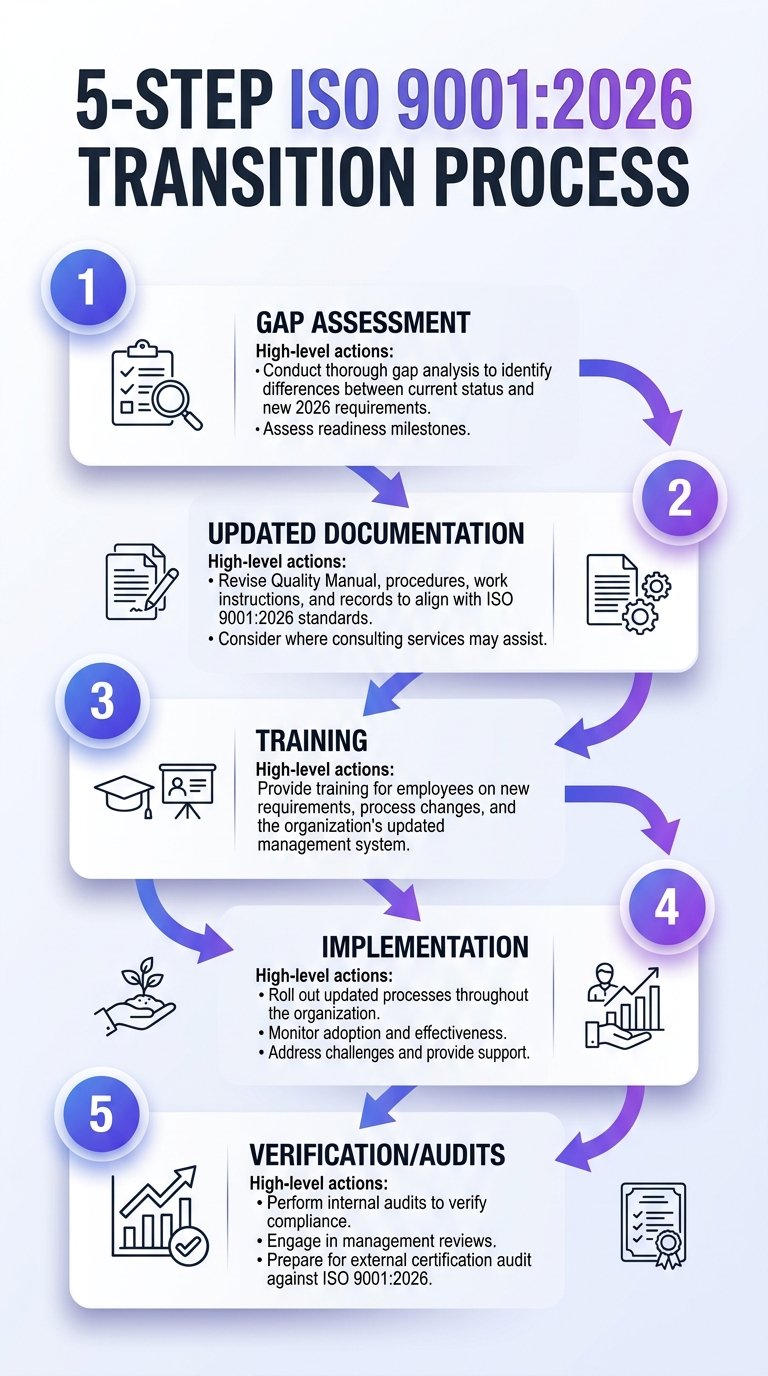
The 5-step ISO 9001:2026 transition process, from gap assessment through verification audits.
How to Meet the New Requirements Without Creating “More Documents”
Here is the uncomfortable truth: many organizations respond to a revision by adding documents and hoping auditors will like the folder. That strategy is slow, expensive, and usually ineffective.
“If documents are used properly, this should never happen, but we all know that they’re frequently ignored in the press of day-to-day work commitments.”
So we design documentation to match real work. We focus on value-added controls, clear responsibilities, and the evidence your team must produce during internal audits and certification audits. Your success depends on how well your documented information supports performance — not whether you can produce it.
- Use process-based documentation: document the “how” that prevents failures and supports outcomes.
- Keep training aligned to controls: if training does not explain the control, you do not have readiness.
- Build audit evidence as you go: internal audit findings should reinforce the new way of working.
What Auditors Will Test During the Transition
Audits do not run on intentions. They run on evidence. The 2026 changes show up in two ways during audits: how leadership drives quality, and how processes control outcomes. So when you plan your transition, do not only prepare answers. Prepare evidence that proves your system works.
- Leadership review evidence: inputs, outputs, follow-up actions, and effectiveness of decisions.
- Internal audit results: how findings lead to corrective actions and how you confirm effectiveness.
- Process controls: records that show performance against requirements and customer expectations.
- Improvement activities: how you reduce recurring issues, not just close nonconformities.
This is why we take auditing seriously. Our internal auditing services include internal audits and supplier audits to support certification readiness. If you want a transition that holds up, you need that feedback loop in the middle of the work, not after.
Choosing the Right Support for Your Transition
Some consultants sell generic templates. We do not. We are professionally trained consultants — ISO 9001 certified ourselves — with over 25 years of auditing and quality management experience, and we won’t rest until we’ve developed a fully customized QMS that boosts your quality and delivery while trimming your cost and error to its absolute minimum.
That mindset matters because your transition plan must match your organization. It is not just “meet the standard.” It is “make your system work better,” so your audits become proof, not hope.
Did you know?
Less than 5% of U.S. manufacturing companies are currently ISO 9001 certified, leaving 571,000 firms without a standardized framework as the 2026 transition begins. Source: The ISO 9001 Group
Related Standards: When the ISO 9001:2026 Transition Influences Other QMS Work
Many organizations run ISO 9001 alongside aerospace, medical device, or environmental management systems. When you build the 2026 requirements into your QMS structure, it often makes other systems easier to integrate, because your process discipline gets stronger.
If you also need aerospace QMS support, a coordinated approach pays off — see our AS9100 consulting services when aerospace requirements and ISO 9001 transition planning overlap. Manufacturers with environmental-compliance contracts often pair the transition with ISO 14001 consulting, since both standards share the same Annex SL structure and can run as one integrated system. For the bigger picture of how we support multiple standards, start with our ISO 9001 consultants and expand from there.

Aerospace suppliers layering AS9100 onto ISO 9001 inherit the same process discipline the 2026 revision demands.
What It Costs You When the Transition Is Left Too Late
Delaying the work typically creates the same set of problems. You rush training, internal audit evidence becomes thin, and corrective actions get crowded into a short window. Even worse, people start asking, “What does the standard mean for our real work?” That question should be answered during the gap analysis phase, before implementation.
- Rushed implementation: changes do not get embedded into daily operations.
- Weak internal audit: you do not uncover and fix issues before the certification audit.
- Inconsistent leadership signals: responsibilities and priorities become unclear.
We prefer you never find out the hard way. That is why our QMS approach is built around phased readiness, evidence generation, and training that matches your system controls.
Next Steps: Start Your Transition Work Now
Start now so your transition does not turn into a last-minute scramble. We want you to build a QMS that genuinely supports quality and delivery — that is the highest return on investment, because it reduces errors and strengthens process reliability.
At AQM we are never satisfied with you simply passing an audit. We are committed to delivering and exceeding your expectations by partnering with you and building a long-term relationship. If you want help planning your ISO 9001:2026 transition, contact American Quality Management. From there, we can confirm fit, share how our phased process works, and map the first steps for your specific situation.
Conclusion
The ISO 9001:2026 transition is about more than updates. It is about leadership, process control, evidence, and building a quality culture that reduces mistakes before they become expensive problems.
We recommend you begin with a gap analysis, run a phased implementation plan, train your team, and generate internal audit evidence while changes are still fresh. That is how you upgrade without chaos — and how you move beyond “paper is secondary” into a fully customized QMS that performs.
Frequently Asked Questions
What are the ISO 9001:2026 transition requirements for existing certified companies?
For existing certified companies, the transition centers on aligning your current QMS to the updated standard through gap analysis, controlled implementation, training, and evidence that proves process conformity. Plan to close gaps early so internal audits can validate effectiveness before certification audits.
How long does the ISO 9001:2026 transition typically take?
The timeline depends on how mature your QMS is and how many processes need real changes. A phased plan built around discovery, gap analysis, implementation, internal audit, and then certification support is the most reliable way to prevent last-minute issues.
Can we handle the transition internally without hiring a consultant?
It is possible, but internal teams often underestimate the evidence and training effort required. If your quality culture, audit experience, or process documentation maturity is uneven, outside support can reduce risk and speed up correct implementation.
What’s the biggest mistake companies make when preparing for ISO 9001:2026?
The biggest mistake is treating the transition like a document rewrite project instead of a process and evidence project. Auditors test whether leadership and process controls work, so your transition plan must generate proof, not just policies.
Does the transition require major documentation changes?
It may require documentation updates, but the requirement is that documented information supports your processes and outcomes. We focus on value-added, properly used documentation, because documents that are ignored during day-to-day work create audit risk.
What should we do first?
Start with a gap analysis that maps the 2026 requirements to your actual processes. Then build a timeline, implement changes in phases, train internal auditors, and run internal audits to confirm effectiveness while you still have time to correct issues.
Is the transition work worth it for small businesses?
Yes. The work improves consistency, reduces costly errors, and helps your team work from clear controls and responsibilities. When the QMS supports real outcomes, the transition becomes an operational improvement, not just compliance.